As the world's leader in metering rod technology for the paper and converting industries,
we thought it might be useful to share some of the most common questions we receive
from customers around the world-and the answers.
A larger rod diameter can improve coating results because of the larger nip area and can add to the working life of the rod. However, diameter is usually determined by the machine manufacturer and the availability of related component parts such as drive couplings and rod holders.
Buschman makes all our metering rods from stainless steel.
For converting applications, we usually recommend a chrome thickness of 0.0003 inches
(0.00762mm). Chrome thickness can be adjusted to suit your needs.
For sizing applications, we usually recommend a chrome thickness of
0.001 inches (0.0254mm). Chrome thickness can be adjusted to suit your needs.
For smoothing applications, we usually recommend a chrome thickness of 0.002 inches
(0.0508mm). Chrome thickness can be adjusted to suit your needs.
A larger wire diameter or thread size will produce a heavier coat weight or
thickness because it has larger thread openings and thus meters more coating.
Customers will sometimes use a smoothing rod as a follow-up process to a
metering rod or other coating method to create a smoother coating result.
This is especially true when using high viscosity coatings.
A basic blunt cut is the most common end and is the least expensive to make.
Special ends are found in a variety of configurations such as single flat, double flat,
squared, drive pin and journals. We recommend keeping drive ends as simple
as possible to keep your rod costs as low as possible.
Shorter rods are individually packaged in polyethylene lay flat tubing and then
grouped and packaged in U-channel board boxes. Longer rods are
individually packaged in paper core tubing and then grouped and packaged
in heavy-duty wooden boxes. All rods are packaged with special protection to
eliminate shifting during transit.
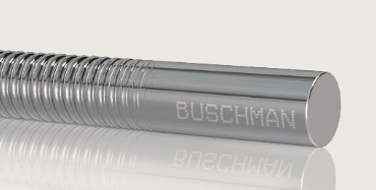
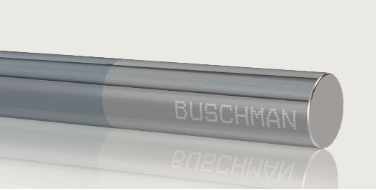
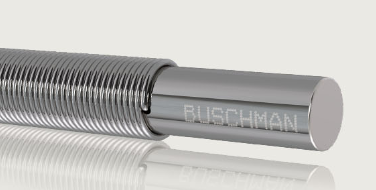
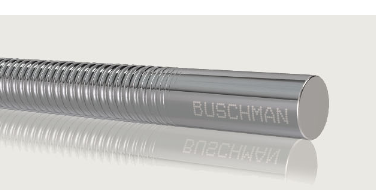
Rods are usually marked on the ends with the Buschman name and the size of
the rod if there are threads. We can mark the rods with additional information upon request.
There are several reasons. First, metering rods apply coating at a more consistent and predictable rate. This allows for a more accurate projection of coating costs. Second, rods do not wear as quickly as blades. Since rods are rotated during operation, the entire circumference of the rod is used in the coating process. Blades can only employ the same edge throughout the coating process. Finally, rods may be used with much faster web speeds. In some high-speed applications blades can experience a 'hydroplaning' effect, which causes non-uniform coat weights. Metering rods can operate in high-speed applications because they channel the fluid better, much like good tires on a wet road surface. Also, because metering rods are constantly turning, loose fibers and filler particles do not accumulate to the same extent as with blades. Top of page
You will discover that a rod has worn when you notice less coating being applied. As the wire or thread surface wears down, the open areas become smaller and thus no longer apply a sufficient quantity of coating. Coating build-up in the rod grooves can also diminish rod performance. When some thread designs are used with more viscous or high solids coatings, the coating can build up in the grooves. This will reduce the area of the openings and thus the metered amount. If this happens, cleaning the rod will usually restore performance.
Hard chrome is much harder than stainless steel, and therefore, wears much more slowly.
You can maximize the working life of a rod by choosing the appropriate rod for your application, keeping the rod clean, and by adjusting the pressure against the rod to maintain optimal metering without causing excessive rod wear. Thread design plays a major role in the working life of a rod. Buschman engineers can work with you to create long lasting rods that suit your application needs.
Routine rod cleaning will minimize streaking and other defects while maximizing coating uniformity and rod life. If using water-soluble coatings, immediately immerse the rods after use in warm water mixed with detergent (Liquid Dish Soap). If using caustic solvents in your coating, such as MEK (methyl ethyl ketone), Toluene, alcohol, turpentine, acetone and lacquer thinner, immerse the rods immediately after use in a container of the same solvent used in the coating. Once the rods have had enough time to soak, use a very soft and fine brass bristle brush and gently scrub the rods in the direction of the wire or threads
Metering rods should be stored in the original packaging until they are used. Care must be exercised when handling rods to avoid damage such as nicks and scratches, which can affect the quality of coating. Used rods should also be stored in a manner that will protect them from damage
A larger wire diameter or thread size will produce a heavier coat weight or thickness because it has larger thread openings and thus meters more coating.
Maximum uniformity of coating is achieved when a rod delivers the appropriate wetting speed. Because of surface tension, a rod with more narrow and rounded threads, whose open areas are closer together will deliver a faster wetting speed than one whose openings are farther apart. When dealing with low viscosity coatings with low solids, a variety of rod profile shapes will deliver a satisfactory wetting speed. When more viscous coatings are used, or coatings with higher solids content it becomes critical to select a rod profile that will deliver a fast enough wetting speed to achieve a uniform coat. Buschman engineers can work with you to create a rod that delivers the best wetting speed for your application needs
Make sure that your rod is turning in a direction opposite to that of the web. This reduces film splitting, which can cause streaking. Handle rods carefully to avoid bending the rod and to prevent scratching or nicking the rod surface. Using a thread profile shape that delivers the proper wetting speed for the coating solution will produce a uniform coating that is free of streaks and other defects.
Streaks are usually found in coatings with a high percent of solids content. Make sure that you choose a thread profile designed to maximize wetting for your application. Such coating solutions may also separate or dry out before reaching the rod. If that is your problem, add a water retention agent to the solution to reduce streaking.
Shadows and/or coat weight variations are often associated with bent rods or uneven wear of the rod, holder or roll cover.
Turning the metering rod evens out surface wear and helps in the distribution of the coating.
Rods generally turn in the opposite direction of the web or roll. This reduces film splitting,
which can cause streaks
A metering rod generally turns somewhere between 10 to 90 RPM depending on the
application. Rod speed is customarily determined through trial and error methods.
Air bubbles are often caused by splash and foaming caused by the excess coating returning
to the pan. The use of proper screens to filter out air bubbles and clumps of particulates
can minimize this effect.
Films are generally less porous than paper, leaving most or all of the coating on the surface making films more susceptible to streaks and rod lines. To achieve a smooth and uniform coating on films, we recommend using a wire-wound rod or a grooved rod with a custom thread profile. Our engineers are ready to work with you to develop the appropriate profile for your application.
The open area of a metering rod is the main variable, which controls coat weight. Other variables controlling coat weight are the profile or shape of the thread, bladder pressure or tension on rod, hardness of roll cover, viscosity of coating, percent of solids, temperature, speed of web as well as a variety of lesser influences
Rod holders can be an intricate part of the coating process. The best rod holders are hot cast in full-length molds instead of being extruded. This gives the rods a more uniform and consistent fit along the entire length of the holder, which reduces rod vibration, increases rod and holder life and promotes a more uniform coating.
Minor changes in coat weight can be made by adjusting viscosity, percent solids, rod pressure, roll cover hardness, coating temperature, web speed, or thread profile on the metering rod. However, for significant changes you will need to change to a different thread size.Top of page
You can reduce your metering rod costs in a number of ways. By ordering in larger quantities and ordering rods with standard ends you benefit from reduced production costs. By working with Buschman engineers to choose rods with a longer working life you can also reduce the number of rods you buy throughout the year. Rod design may also impact other areas of cost for your application. Buschman engineers can work with you to reduce those costs as well.
To replace fiber with starch, you simply reduce the fiber content of your paper then select a rod that will provide a thicker coat weight for your starch based sizing. Buschman engineers can work with you to create a thread profile that provides the optimal coat weight to reduce your fiber costs.
To replace starch with fiber, you simply increase the fiber content of your paper then select a metering rod that will provide a thinner coat weight for your starch based sizing. Buschman engineers can work with you to create a thread profile that provides the optimal coat weight to reduce your starch pickup.
When you use a grooved rod with a customized thread profile from Buschman, you will be using a metering rod created specifically for your application. The thread profile will be optimized for superior coating performance as well as to minimize overall costs in your coating operation.Top of page
The thread profile on a metering rod can significantly affect the quality of the final coat as well as the runnability and cost of the coating operation. Depending on the requirements of your application, it may be better to make the switch. Wire-wound rods only offer one thread profile whereas grooved rods can be made in an infinite number of thread profiles--including those that match the profile shape of wire-wound rods, but without the problems associated with the pinch area between the wires. To find out if switching to grooved rods is right for your application, contact us. We will be happy to work with you to determine the right metering rod for your particular application. Top of page
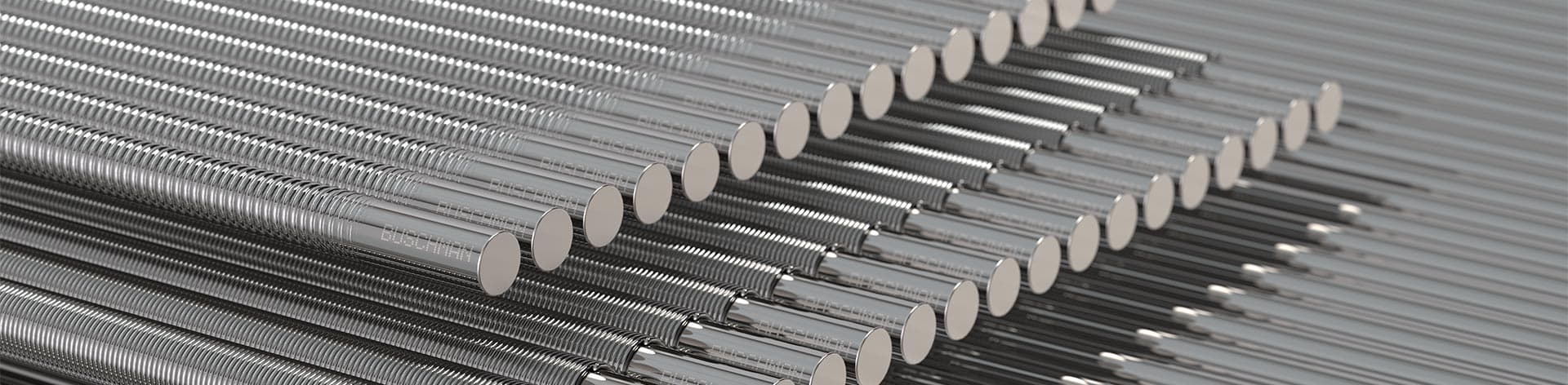
A grooved metering rod is a stainless steel rod that is rolled through a set of dies to form a thread into the rod surface. These rods are used in paper mills and converting mills to coat starches, pigments, adhesives and other coatings onto paper, films, foils, cardboard and a variety of other web surfaces. Threads can be created to conform to many profiles. These profiles can be customized to optimize the coating process, thus allowing for more precise and cost effective metering than that of wire-wound rods. These rods are usually chrome plated to extend working life.

Grooved rods are sized by their equivalent wire size. The equivalency between grooved rods and wire-wrapped rods is found when the total area of openings on rods of the same length is equal.
The thread profile on a metering rod can significantly affect the quality of the final coat as well as the runability and cost of the coating operation. Depending on the requirements of your application, it may be better to make the switch. Wire-wound rods only offer one thread profile whereas grooved rods can be made in an infinite number of thread profiles--including those that match the profile shape of wire-wound rods, but without the problems associated with the pinch area between the wires. To find out if switching to grooved rods is right for your application, contact us. We will be happy to work with you to determine the right metering rod for your particular application.Top of page
A smoothing rod is a stainless steel rod that has been hard chrome plated and polished to create a smooth and shiny finish. Smoothing rods do not have any wire or threads on the surface. They are primarily used to apply clay coatings to paperboard, and to distribute higher viscosity coatings evenly and smoothly.
A smoothing rod has a smooth surface with a hard chrome finish. Smoothing rods usually
have a surface finish of 6-12 Ra .
For smoothing applications, we usually recommend a chrome thickness of 0.002 inches (0.0508mm). Chrome thickness can be adjusted to suit your needs. Plating thickness now available up to 0.003in (0.075mm) thick.
Customers will sometimes use a smoothing rod as a follow-up process to a metering rod or
other coating method to create a smoother coating result. This is especially true when using
high viscosity coatings. Top of page
Rod holders can be an intricate part of the coating process. Holders are manufactured from two primary materials; Hot Cast Polyurethane (PU) & Polyethylene (PE). Our holders are precision manufactured to give the rod a more uniform and consistent fit along the entire length of the holder, which reduces rod vibration, increases rod and holder life and promotes a more uniform coating.
Top of page
A wire-wound metering rod, often called a Mayer rod after its inventor, Charles Mayer, is a stainless steel rod around which stainless steel wire is tightly wrapped. The wound wire creates a thread that is always the same profile (a half circle). Wire size is determined by the diameter of wire wrapped around the rod. These rods are usually chrome plated to extend working life. Wire-wound rods are used on coating machines to apply pigments and other coatings onto various web surfaces.

A double-wrapped wire-wound metering rod is designated a size based on its equivalent wire size. The equivalency is found when the total area of the openings on wire-wound and double-wrapped wire-wound rods of the same length is equal.

A double-wrapped wire-wound metering rod is designated a size based on its equivalent wire size. The equivalency is found when the total area of the openings on wire-wound and double-wrapped wire-wound rods of the same length is equal.
The size of a wire-wound metering rod is based on the diameter of wire wound around the rod. The size is usually shown as the actual diameter of wire multiplied by 1000. Thus a size 10 wire-wound rod would be made with wire 0.010 inches in diameter. Smaller size rods have smaller open areas and thus apply less coating than larger size rods. Please be aware that other manufacturers may use an entirely different size designation.
The wire used is 300 series stainless steel.
A larger wire diameter or thread size will produce a heavier coat weight or thickness
because it has larger thread openings and thus applies more coating. Top of page